
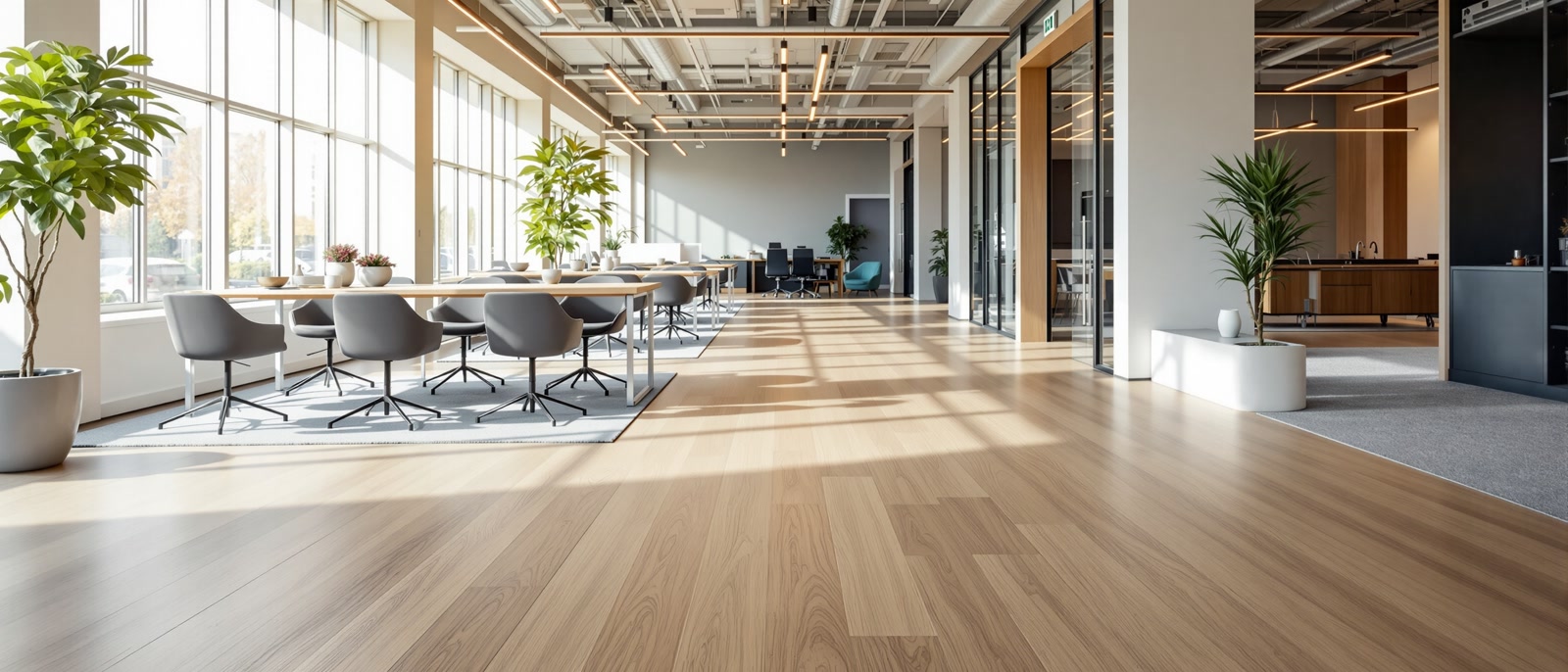
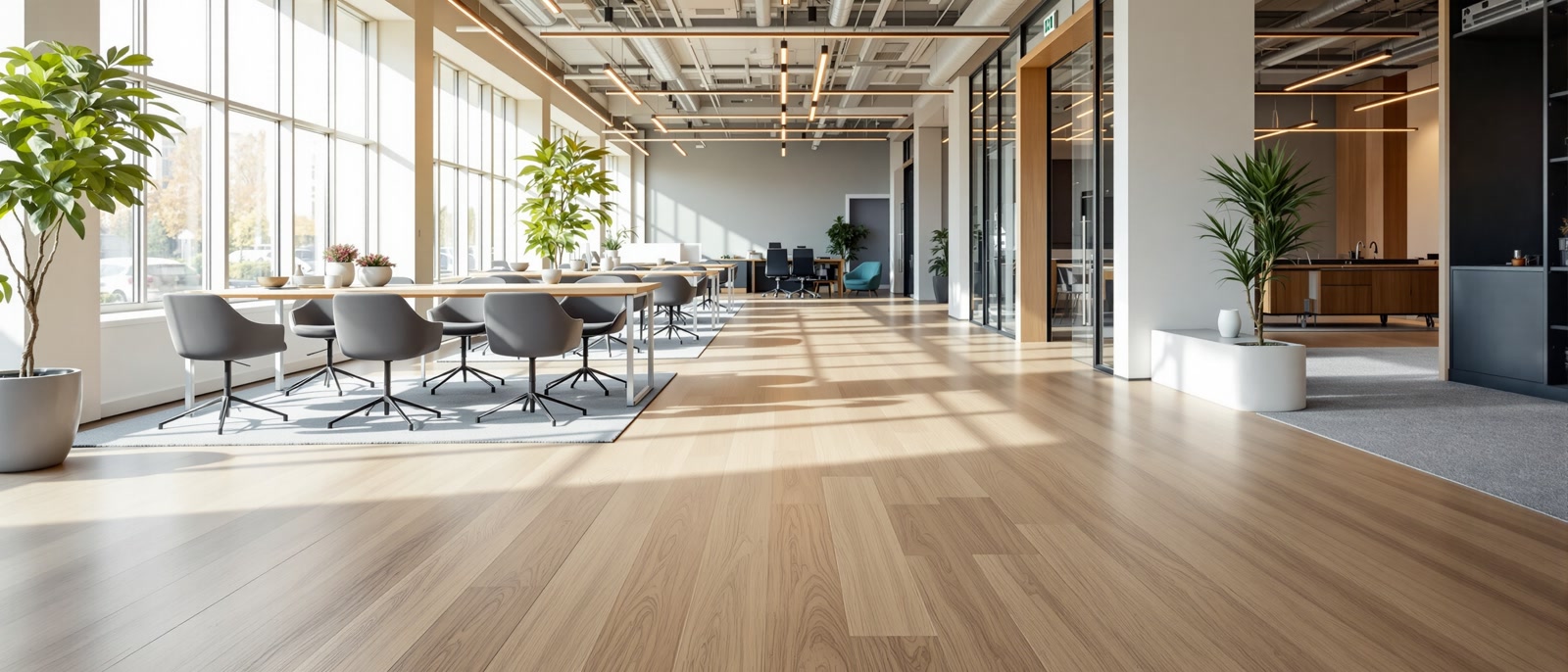
Choosing the Right Commercial Flooring for Your Hertfordshire Business
Learn how to choose the right commercial flooring for your Hertfordshire business. Expert guidance on office, school, and healthcare flooring specifications.
Request A QuoteHow to Choose Commercial Flooring for Hertfordshire Businesses
Choosing commercial flooring for Hertfordshire businesses means matching traffic type and intensity, sector rules, total cost of ownership, and UK compliance, not picking a single "best" floor. Use this four-factor framework before reviewing any material:
Traffic
Foot or wheeled, wet or dry, peak or average use.
Sector
The specific demands of your building, such as school corridors versus healthcare hygiene.
Budget / TCO
Whole-life cost including maintenance and disruption, not just the upfront price.
Compliance
UK classifications and sector standards that dictate construction and detailing.
Commercial flooring in Hertfordshire must withstand sector-specific demands, whether that is the high footfall of school corridors or the strict hygiene requirements of healthcare. This is a specification problem, not a style choice, and our commercial flooring services cover every stage from survey through to installation. Approaching the decision this way prevents the two most common specification failures: under-building the wear layer for the actual traffic, and choosing an aesthetic before confirming the compliance requirements.
Match Flooring to Traffic Intensity and Type
Traffic class, foot versus wheeled, wet versus dry, and peak versus average, determines construction and wear performance more than colour or how "durable" a floor looks. Use this matrix to identify the primary demand on your floor before you consider materials:
| Traffic Type | Key Demand | Typical Environment |
|---|---|---|
| Dry office circulation | Acoustic comfort and appearance retention | Open-plan offices, meeting rooms |
| Education corridors | High footfall wear resistance | School corridors, classrooms |
| Clinical or wet areas | Hygiene continuity and slip resistance | Healthcare treatment rooms, kitchens |
| Mixed public routes | Both foot and wheeled load resistance | Entrances, retail, public buildings |
There is no single best high-traffic floor. High traffic still splits by moisture, hygiene, and wheeled load, so match the construction to the specific conditions. A heavy-duty vinyl that performs well in a dry school corridor will not meet the hygiene requirements of a clinical wet area, and a carpet tile that suits an office will fail quickly in a mixed public entrance with wheeled traffic. Resist using residential products in commercial traffic; they will fail early under the wear and maintenance demands of a business environment. The key distinction is commercial classification verifying the construction, not the visual appearance of the product.
UK Compliance, Hygiene Continuity and Classification
UK commercial specification uses BS EN ISO 10874 wear classes, typically 33 or 34 for high-traffic education, and system detailing, not a generic "commercial vinyl" label. The Department for Education durability guidelines point to these classifications for school flooring. The classification number tells you the construction is verified for commercial intensity; without it, you are relying on a marketing claim rather than a tested standard.
1Education
Polyflor's Concept 70 range, with its 0.70mm wear layer, is engineered specifically for high-traffic educational spaces. This is a source example, not the only option, but it shows the level of construction required. The wear layer thickness directly relates to how much abrasion the floor can absorb before the design layer is exposed.
2Healthcare
Infection control requires continuous hygienic surfaces. Altro and Polyflor safety vinyl systems are frequently installed in NHS Trust facilities across Hertford, Ware, and Stevenage. These products can be hot-welded at seams and integrated with coved skirtings to create the necessary continuous, hygienic surface. The welding and coving are not optional extras; they are the detailing that prevents bacteria harbouring in joints and at wall junctions.
3When not to choose carpet tile
Avoid carpet tile in wet clinical or hygiene-critical areas where a continuous, cleanable surface is mandatory. The seams and texture of carpet tile make it impossible to achieve the infection control standard required in treatment rooms and clinical corridors. Design is allowed only inside a compliant system, so specify the construction first, then the colour.
Specify by Sector, Not by a Single Best Floor
Sector constraints decide construction; there is no universal best commercial covering. Work through the system family that fits your building type, then refine from there. Each sector below has a different primary failure mode, so the system you choose must address that risk first.
Acoustic & Modular
Choose carpet tiles for acoustic comfort, modular replacement of damaged tiles, and design flexibility. Interface and Forbo are widely specified across Hertfordshire business parks for their durability and backing technologies such as GlasBac. The modular format is a facilities management advantage: a damaged tile can be lifted and replaced without disturbing the surrounding floor or closing the office. Explore commercial carpet tiles for office environments.
Heavy-Duty Vinyl
Use 33/34 heavy-duty vinyl such as Polyflor Concept 70 with its 0.70mm wear layer for high-traffic educational spaces. The classification matters more than the brand; a 33 or 34 rated product is verified to handle the daily footfall of corridors and classrooms. Install school flooring during holiday periods to avoid disrupting term-time learning. This timing protects both the installation quality and the education schedule.
Welded Safety Vinyl
Specify Altro and Polyflor safety vinyl systems with welded seams and coved skirtings for continuous, hygienic surfaces. The system, not the vinyl alone, delivers infection control. Hot-welded seams eliminate gaps where bacteria can collect, and coved skirtings remove the internal corner where dirt and moisture accumulate. This is the standard approach for healthcare flooring in locations such as Hertford, Ware, and Stevenage.
Budget as Total Cost of Ownership, Not Upfront Price
Always consider total cost of ownership rather than upfront price. A correctly specified, professionally installed floor reduces maintenance spend over its lifecycle versus cheaper alternatives that fail classification. The cheapest quote on day one is frequently the most expensive floor over five years once replacement, downtime, and disruption are counted.
Replacement of modular tiles
Carpet tiles allow single-tile swaps, avoiding full-sheet replacement costs when one section is damaged.
Hygiene downtime
Seams that fail hygiene requirements create cleaning and closure costs in clinical spaces, potentially taking rooms out of use.
Premature wear
An under-specified wear layer fails early, adding replacement labour and disruption before the expected lifecycle is reached.
Disruption as a cost
Installing during term time or clinical hours creates operational costs beyond the flooring price, including temporary accommodation and lost room usage.
Treat budget as specifying a system, including wear layer, welding, and backing, not just choosing a sample-board colour. A mid-cost floor with the correct classification and professional installation will outperform a cheaper uncertified product in total cost.
Survey, Install Windows and Specialist Specification
Specify after a survey. Installation quality, including welding, backing, and classification knowledge, is part of the floor system, not an afterthought. A survey measures the subfloor condition, identifies moisture levels, and confirms the traffic and sector requirements before any material is ordered.
1. Survey
Measure subfloor condition, moisture levels, and confirm traffic and sector requirements before any material is ordered.
2. Plan Install Window
Plan school holiday installs across Hertfordshire to avoid term-time disruption, and schedule clinical sites around occupancy so treatment rooms are not taken out of service during busy periods.
3. Specialist Install
A specialist with experience in specified commercial systems reduces the risk of seam, hygiene, and classification failure.
Our commercial flooring services cover survey through installation, so the specification and the installation are handled as one system rather than separate stages.
Common mistakes include using residential products in commercial traffic, fitting carpet in wet clinical areas, ignoring the maintenance regime, and installing in term time. Each of these errors undermines the floor's performance and increases lifecycle cost. The next step is a survey and specification, not a fast purchasing decision.
Frequently Asked Questions
Quick answers to common commercial flooring questions from Hertfordshire businesses.
Is there a single best commercial flooring type for Hertfordshire businesses?
No. The right flooring depends on traffic type and intensity, sector rules, total cost of ownership, and UK compliance. What works for a business-park office is wrong for a school corridor or a healthcare treatment room. The decision is a specification problem across four axes, not a choice of one superior material.
What is the best commercial flooring for high traffic?
High-traffic floors split by moisture, hygiene, and wheeled load. For dry education corridors, a 33/34 classified vinyl such as Polyflor Concept 70 works well. For wet clinical areas, a welded safety vinyl with coved skirtings is required. For mixed public entrances with wheeled traffic, a construction rated for both foot and wheeled load is needed. There is no single answer.
How should I choose commercial flooring for an office?
Prioritise acoustic comfort, modular replacement, and design flexibility. Carpet tiles from Interface or Forbo, with backing technologies like GlasBac, are widely specified across Hertfordshire business parks for these reasons. The modular format allows individual damaged tiles to be replaced without closing the office or disturbing the surrounding floor.
Are carpet tiles a good choice for Hertfordshire business-park offices?
Yes. Carpet tiles offer acoustic comfort, easy replacement of damaged sections, and design flexibility. They are a system that supports ongoing facilities management, allowing individual tiles to be swapped without disrupting the whole floor. This modular repair advantage is a key reason they dominate office specification.
What flooring is suitable for schools and colleges under DfE durability guidance?
Department for Education durability guidelines typically require BS EN ISO 10874 classifications 33 or 34. Polyflor's Concept 70 range, with a 0.70mm wear layer, is one example engineered for these high-traffic educational spaces. The classification verifies the construction rather than relying on visual appearance.
What flooring is used for healthcare hygiene and infection control?
Healthcare settings require continuous, hygienic surfaces. Altro and Polyflor safety vinyl systems are frequently used, installed with hot-welded seams and coved skirtings to prevent infection control failures at joints and edges. The welding and coving are as important as the vinyl itself for achieving the required hygiene continuity.
Should I choose commercial flooring on upfront price or total cost of ownership?
Choose on total cost of ownership. A cheaper floor that fails classification will cost more through premature wear, hygiene downtime, and replacement disruption. The upfront price is only part of the lifecycle cost, and under-specification is the most expensive mistake you can make.
Why does professional commercial installation matter?
Welding, backing, and classification knowledge are part of the floor system. A specialist experienced with specified commercial systems reduces the risk of seam, hygiene, and classification failure, protecting the lifecycle cost of your investment. Poor installation can invalidate the performance of a correctly specified product.
Is the "rule of 3 for flooring" a recognised UK commercial specification rule?
No. It is not a recognised UK commercial flooring specification rule. UK specification relies on standards such as BS EN ISO 10874 wear classes and sector-specific guidance, not this phrase. Treat any advice based on this rule as unverified.
Need Help Choosing the Right Floor?
Request a quote and our specialists will survey your site, assess your traffic and sector requirements, and specify a flooring system built for your total cost of ownership.
Request A Free Site Survey